
Someone told me recently that doing cardio before lifting is sabotage for your gains. I respectfully disagree — and the science backs me up. The truth about cardio and strength training is significantly more nuanced than the fitness industry wants you to believe, and the answer depends entirely on your goals, your timing, your nutrition, and your training intensity. Let me break it down honestly.
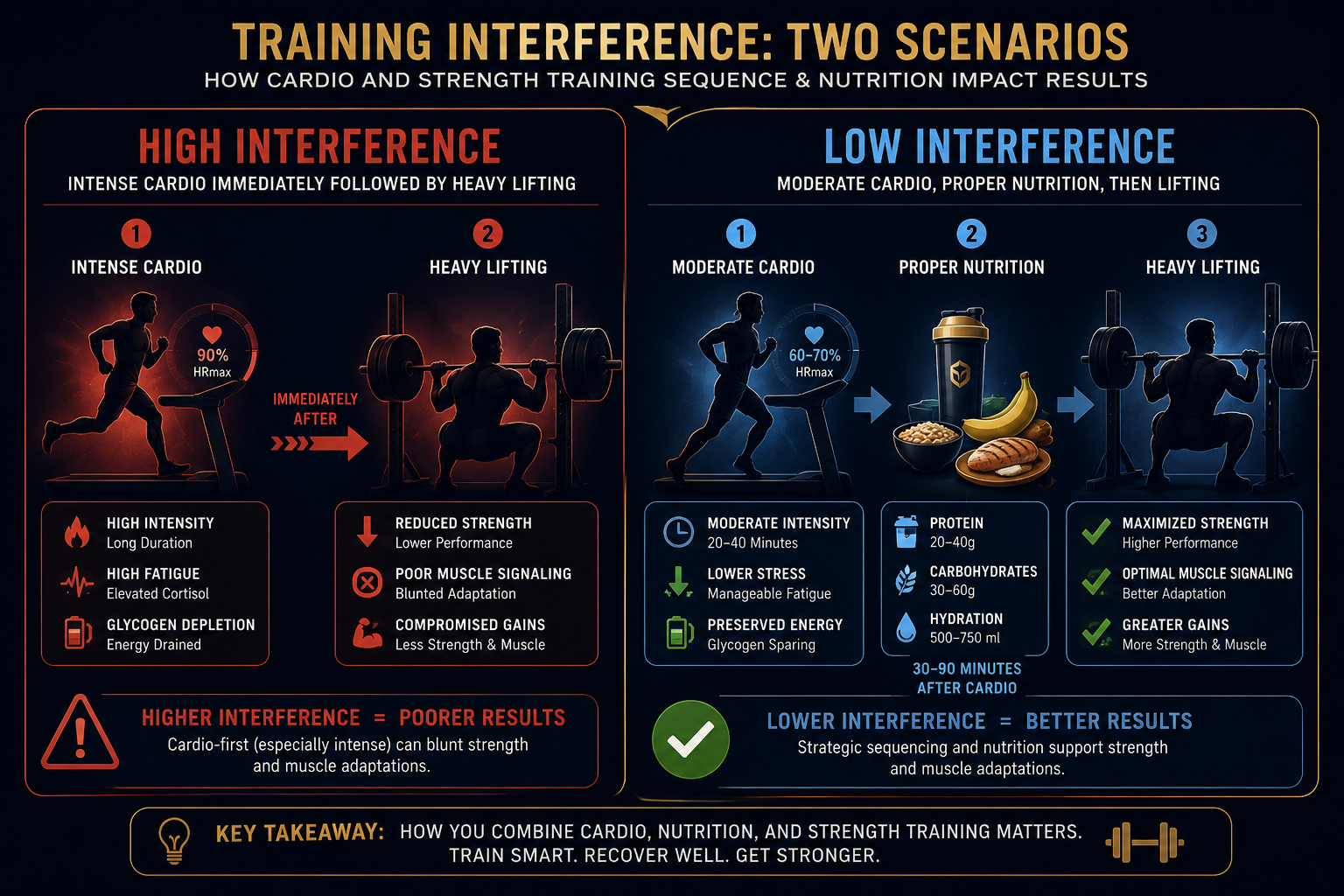
The interference effect is a real and documented physiological phenomenon. When you perform cardiovascular exercise immediately before strength training, your muscles are pre-fatigued, your glycogen stores are partially depleted, and your central nervous system has already been taxed. For competitive powerlifters and bodybuilders chasing maximum strength or hypertrophy numbers, this matters significantly. For the vast majority of people training for body composition, general health, and sustainable fat loss — it matters far less than the fitness industry suggests.
The research consistently shows that the interference effect is most pronounced when cardio and lifting are performed back to back at high intensity with no nutritional support. Change any one of those variables and the effect diminishes meaningfully.
Not all cardio is created equal when it comes to pre-lifting performance. Ten to fifteen minutes of light cycling or walking before lifting actually improves performance by elevating body temperature, increasing blood flow to working muscles, and preparing the cardiovascular system for the demands ahead. That is not interference, that is a warmup.
Thirty minutes of moderate running before lifting sits in the middle of the spectrum. Your lower body will experience some pre-fatigue and your glycogen stores will be modestly reduced, but your upper body performance will barely be affected and your overall training quality will remain high provided your nutrition is dialed in. Forty-five minutes of high-intensity interval training immediately before a heavy compound lifting session is where the interference becomes genuinely meaningful and worth restructuring if your schedule allows.
Here is the part of this conversation that gets left out almost every time. Whether cardio before lifting compromises your gains has as much to do with what you ate before training as it does with the order of your workout itself.
Training fasted — meaning you have not eaten for several hours — before a combined cardio and lifting session significantly increases the risk of muscle protein breakdown. Your body, lacking available glucose from food, will begin mobilizing amino acids from muscle tissue for energy during the strength training portion of your session. This is where real muscle loss risk lives — not in the cardio itself, but in the combination of fasted training and glycogen depletion.
The solution is straightforward. A complete meal containing adequate protein and carbohydrates consumed one hour before training provides the glycogen your muscles need for both the cardio and the lifting session. Even a small fast-digesting source of protein and carbohydrate immediately before training provides meaningful protection against muscle breakdown during a combined session.

The interference effect matters most to the people for whom maximum muscle hypertrophy or peak strength performance is the primary training goal. For competitive bodybuilders and powerlifters, restructuring their training to separate cardio and lifting sessions by several hours or placing cardio after lifting rather than before is a legitimate and evidence-supported optimization.
For the population I coach — busy professionals training for sustainable fat loss, improved energy, better body composition, and long-term health — the order of cardio and lifting is significantly less important than the consistency of showing up, the quality of nutritional support around training, and the total volume of work performed over weeks and months. A person who consistently performs thirty minutes of moderate cardio followed by thirty-five minutes of hard lifting five days a week will produce far better body composition results than someone who spends that same time optimizing their training order while missing sessions.
Consistency beats optimization every single time.
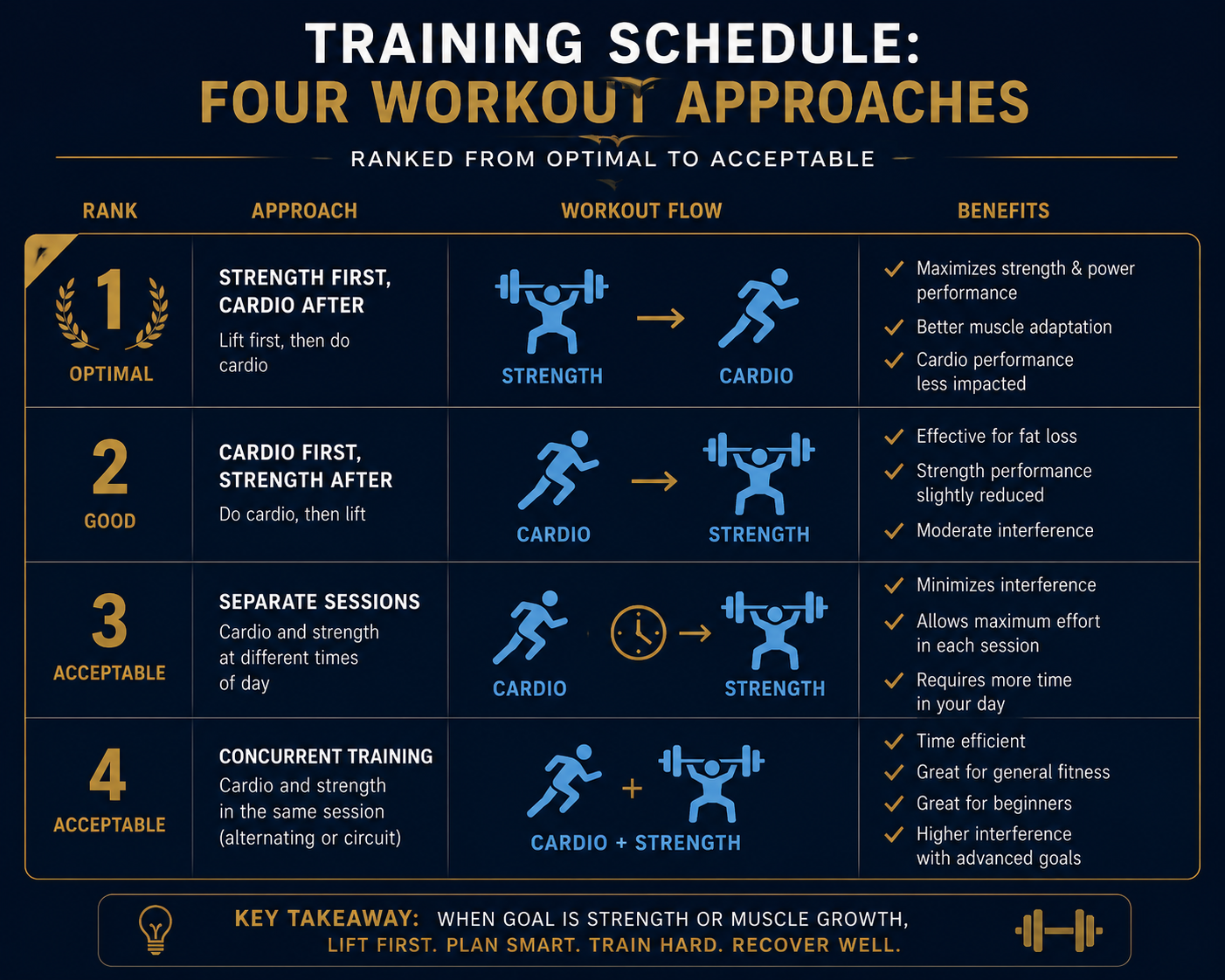
If your schedule gives you flexibility, here are the evidence-supported approaches ranked from most to least optimal for body composition:
Separate morning and evening sessions with a full meal between them — this is the gold standard and eliminates any meaningful interference effect entirely.
Lifting before cardio in a single session — your strength and power output will be at their peak at the start of your session and the cardio serves as an active cooldown afterward.
Light to moderate cardio as a warmup followed immediately by lifting — completely acceptable and in many cases performance-enhancing rather than compromising.
Moderate steady-state cardio followed by lifting with proper pre-workout nutrition — a solid and practical approach for people with limited training windows.
Cardio before lifting is not sabotaging your gains. Inadequate nutrition before and after training is sabotaging your gains. Inconsistency is sabotaging your gains. Under-eating protein is sabotaging your gains. Chronic sleep deprivation is sabotaging your gains.
The order of your cardio and lifting matters at the margins. Everything else matters at the foundation. Build the foundation first.
If you are eating well, sleeping adequately, training consistently, and hitting your protein targets , do your cardio whenever your schedule demands it and trust that the work is adding up in your favor.
At Munky Fitness I coach real people with real schedules and real constraints. Your training program is built around your actual life, not an ideal training environment that exists only in a textbook. If you want personalized guidance on how to structure your nutrition and training for sustainable fat loss and long-term health, book a free thirty-minute consultation below.
.jpg)